close


Aino Halonen


My Projects

The WayPass
A smart crosswalk system to empower those with mobility challenges.

The WayPass
WayPass is an interactive system designed to enhance accessibility and independence for individuals with mobility challenges. Utilizing sensor-based activation, customizable crossing times, and real-time feedback, the system transforms urban navigation into a safer and more inclusive experience. By addressing mobility barriers in Los Angeles, WayPass empowers users to navigate public spaces confidently while seamlessly integrating with existing transit infrastructure.

Problem
Navigating public spaces in Los Angeles is often unsafe and inaccessible for individuals with mobility challenges. Short crossing times, unsafe traffic conditions, and poorly designed infrastructure create significant barriers, leaving many unable to move independently or confidently. WayPass tackles these issues by addressing the lack of inclusive transit solutions, focusing on sensor-based crossing support and real-time accessibility tools. Throughout the project, I faced challenges ensuring the integration of advanced technology into a user-friendly system and designing solutions for a diverse range of needs. Overcoming these required balancing technical innovation with simplicity, ensuring the system was intuitive while maintaining reliability. By incorporating user feedback, WayPass was refined to deliver practical, life-changing solutions for underserved communities.
Insights
Public infrastructure often fails to accommodate individuals with mobility challenges, creating unsafe and stressful conditions. Users emphasized the importance of intuitive systems with clear feedback to build trust and confidence, highlighting that simplicity is key to accessibility. Addressing these barriers not only improves safety but also empowers individuals, fostering independence and inclusion. However, the challenges extend beyond technology; external factors like uneven sidewalks and poorly maintained crosswalks must also be addressed for a comprehensive solution. Ultimately, thoughtful design that keeps advanced technology in the background allows users to seamlessly interact with the system and focus on their needs.


Solution
WayPass is a sensor-based accessibility system designed to empower individuals with mobility challenges to navigate public spaces safely and independently. By leveraging automated range detection, the system customizes crossing times and provides real-time visual, haptic, and audio feedback, ensuring ease of use without overwhelming users with technical complexity. The design focuses on seamless integration with existing infrastructure, prioritizing user needs through intuitive interactions while addressing broader accessibility issues in urban transit. WayPass transforms mobility by creating a safer, more inclusive experience for all.
NeuraLearn
Making learning accessible for any and every mind.
NeuraLearn
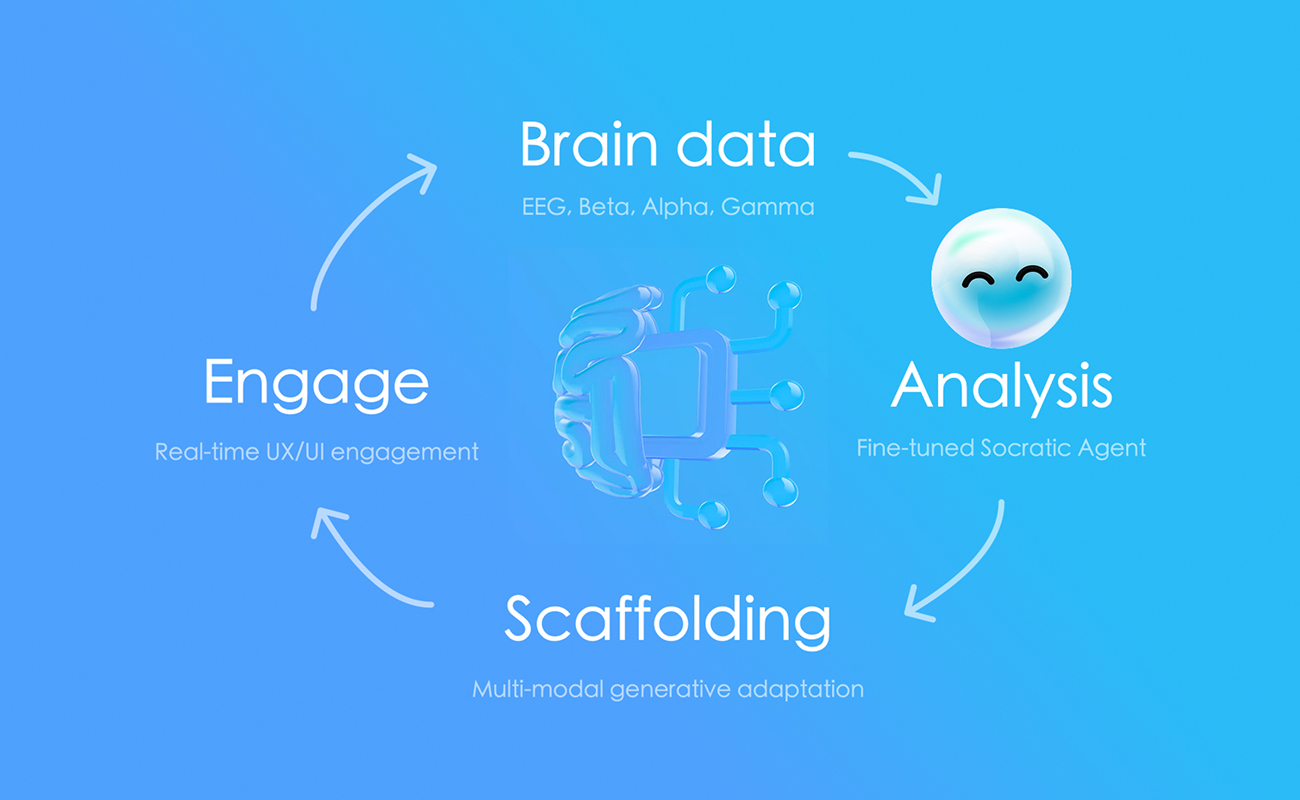
NeuraLearn is a speculative learning system for ADHD college students, built around one idea: protect the productive struggle that real learning requires, and clear only the friction that does not serve the student. Most AI tools do the opposite. They optimize for speed and completion, hand over answers, and quietly remove the cognitive work that learning depends on. For neurodivergent students, who are already failed by a one-size-fits-all education system, that shortcut deepens the gap instead of closing it. The NeuraLearn system centers on an AI agent named Sage. Sage never hands over the answer. It asks, reframes, and re-presents the material, guiding students to their own conclusions while reading their cognitive state to decide when and how to adjust. Built in mixed-reality, this demo simulates cognitive signals rather than live hardware, so people can stand inside the proposal and feel what a system that guides, instead of answering, is actually like. NeuraLearn is research to be continued at Harvard's MDE program, where the work moves toward a closed-loop architecture and a tested system.

Problem
Neurodivergent students are failed by an education system built for an average learner who does not exist. The numbers are stark. Only 58% of neurodiverse students graduate, against 79% of students without disabilities, and just 15% of students with ADHD finish a four-year degree. These students are not failing because they cannot learn. They are failing because the conditions were never built for how they think. Now there is a new pressure. 89% of US college students have used AI to do their schoolwork, and the students the system fails hardest are the ones reaching for the tool that lets them skip the work entirely. Current AI rewards speed, completion, and checking boxes, while learning requires productive struggle, retention, and the ability to apply what you learned. Research from the MIT Media Lab found reduced neural connectivity in people who used AI to write instead of doing it themselves. Offloading physically shows up in the brain, and it damages everybody, especially the students who can least afford it.
Insights
The work moved through several stages: First, secondary research established that the gap was documented rather than personal, drawing on graduation data, AI usage surveys, and neuroscience on cognitive offloading. Second, I defined a design ethos for the agent, Sage, whose toolkit deliberately excludes handing over answers, so it can ask, reframe, and re-present but never solve for the student. Third, I built the spatial prototype in Spline, SwiftUI, and RealityKit, running on Apple Vision Pro with simulated cognitive signals rather than live hardware. Fourth, I engineered a way to capture attention. Apple blocks raw eye gaze on visionOS for privacy, so I reframed the question from where the eyes point to where the head points, polling ARKit head pose at about 60 Hz and processing the logs through a Python pipeline. Fifth, I ran user testing with four participants, two neurotypical and two with ADHD. The strongest insights were that ADHD users wanted agency, not rescue, and that Sage's constant presence could itself pull focus from the task. There was clear need for this kind of system support, but introduced earlier in life to support critical growth stages, milestones, and years of self-blame.


Solution
To study attention on a platform that blocks eye-tracking, I built a head-pose capture system that produces per-scene heatmaps and trail overlays on the recording. Testing with four participants surfaced clear signals: ADHD users want agency, not rescue, which validated the guide-not-hand-over principle; Sage worked as a body double; and its floating presence and split spatial layout added cognitive load worth redesigning. The honest open question that remains is telling productive struggle from unproductive struggle in real time, which is exactly what the next phase of the research will go after.
