


EveryBot
Project Description
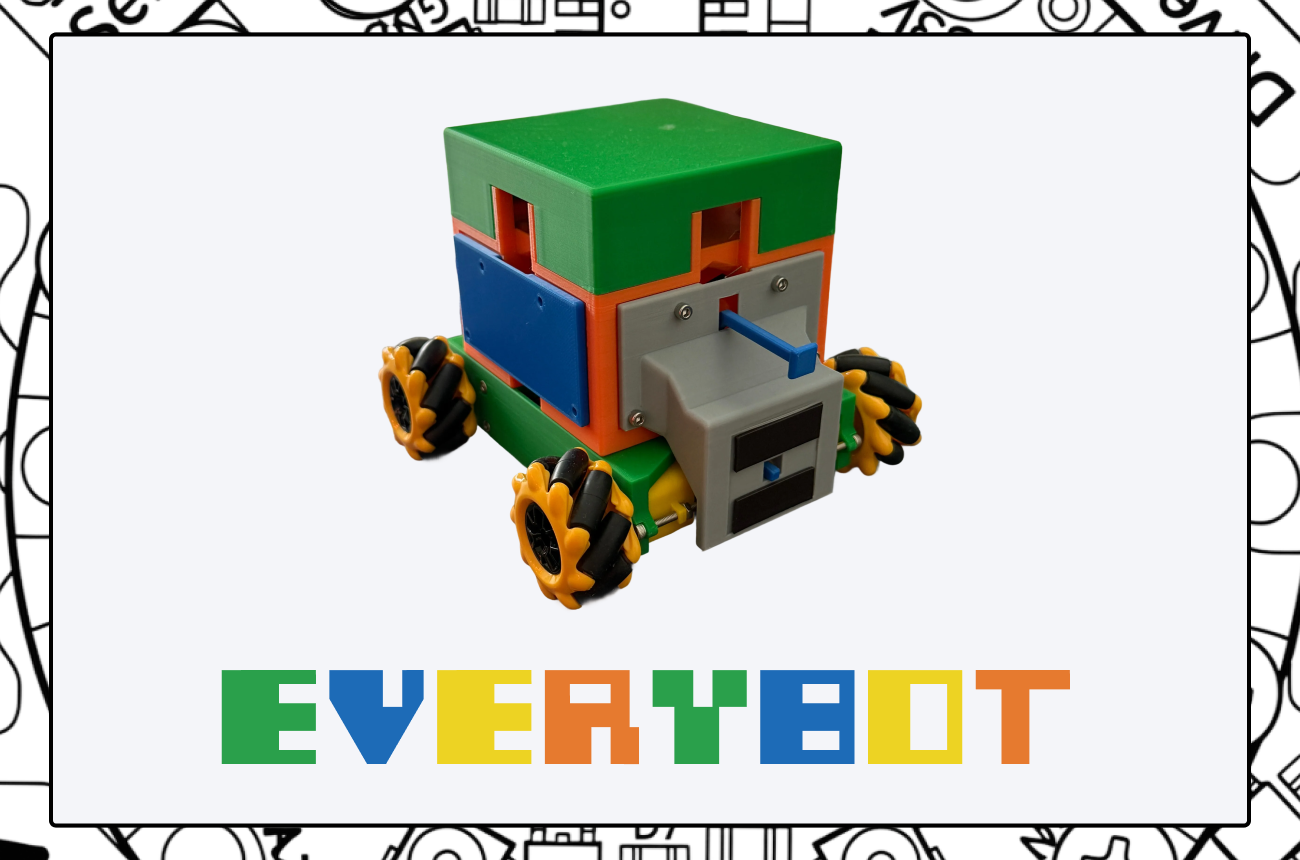
I found that learning robotics in middle and high school was challenging for students if a robust robotics program was not offered at their school. Some of the limiting factors include: high cost, complexity of electronics, and not knowing where to start. My solution centers on three ideas: off-the-shelf electronics, 3D printed parts, and universal connectivity. This creates an accessible robot system where it is easy to learn robotics. 3D printing allows students to use CAD to design parts instead of making a robot using parts premade and predetermined by a manufacturer. This encourages students to learn engineering principles, develop their mechanical thinking, and improve their coding skills. 3D printing makes it easy to modify and design parts to accommodate different electronics. The robot I have built is phase one with everything needed to play a simple game. The long-term vision is building a living, open-source platform. One where the maker and education community contribute new parts, configurations, and ideas, and the robot keeps evolving beyond what I could build alone.
Problem
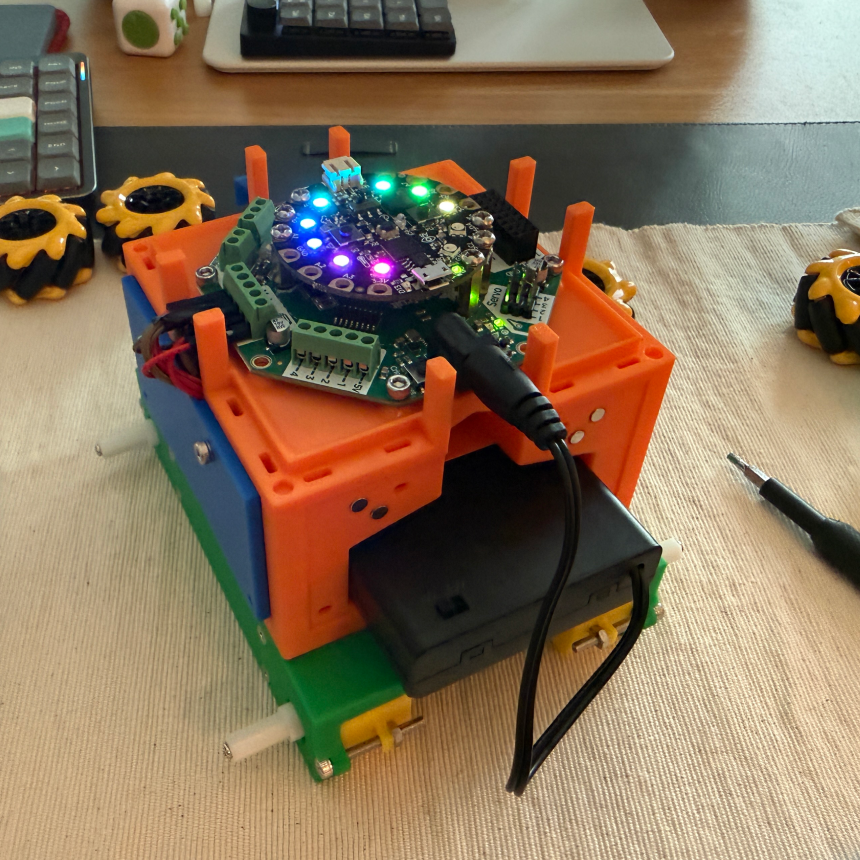
In high school I competed on a FIRST Robotics team and now volenteer as a student mentor for team 4201, the Vitruvian Bots. Through these experiences, I found that learning robotics for middle and high school students was challenging where a robust robotics program was not offered in school. Part of the reason why robotics is difficult to get into is the high cost, complex electronics, and knowing where to start can be hard. I'm not the only one who felt this way. When I looked at what students and educators were saying online, the same frustrations I had kept coming up. The community consistently pointed toward Arduino-based systems as the solution, they are inexpensive, beginner-friendly, and well-documented, especially from online stores like Adafruit. The community already knows what it needs. It just doesn't have the platform yet.
Insights
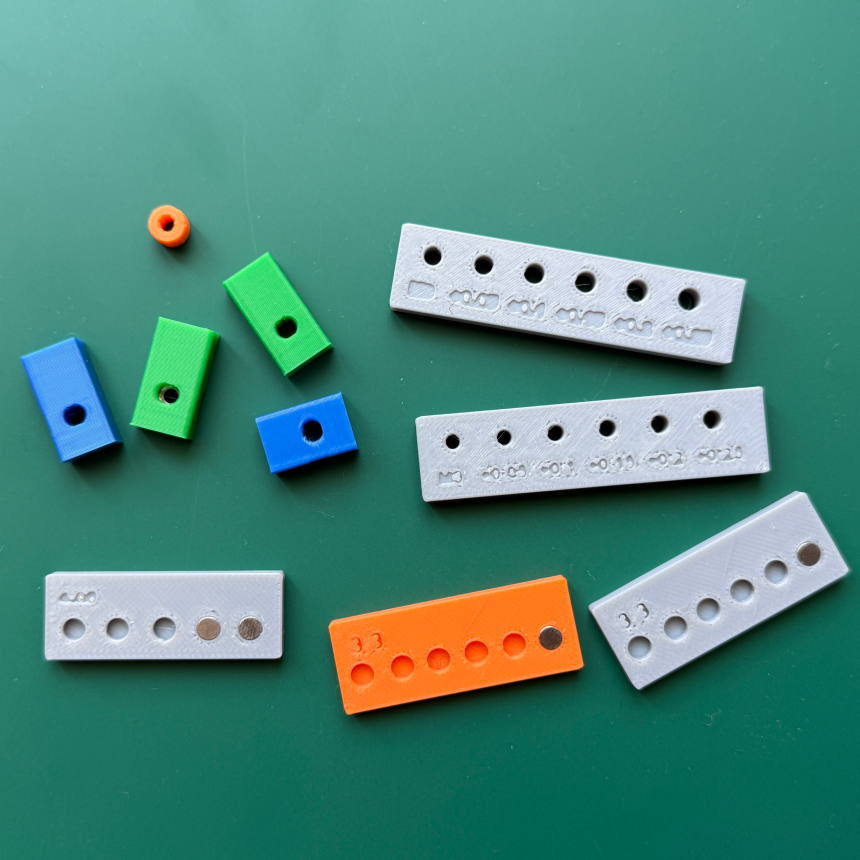
Target Audience: Targeting middle and high school students, this system is designed to scale as students learn. As students start out, they can download and print robot parts, but asr they gain more experience and knowledge, they can start to design parts using CAD for the system. The robot system is well suited for this range, as robot kits are expensive, confusing, and can be difficult to get started with. 3D printing allows students to give their robot new functions and modify parts within a day and at low cost. Competitive analysis: The current market for educational robot kits is dominated by expensive, proprietary systems like VEX ($820–$4,370) and discontinued products like LEGO Mindstorms. CyberBrick by Bambu Lab is the closest competitor to my vision. It is inexpensive, community-driven, and Arduino-compatible. However, it's tied to Bambu Lab's ecosystem and there is no standardized 3D printable system for the community to build off of. This leaves a gap in affordable, open source robotics platform built specifically for students learning to 3D model and program. Netnography: Real users (students, educators, and hobbyists) confirm the problem firsthand. Robot kits are too expensive, rely on proprietary parts, and don't teach mechanical fundamentals. The community consistently recommends Arduino-based systems for their low cost, beginner-friendly programming, and strong online documentation. However, there is a need for open source and easy to assess kits that use Arduino-based systems. Secondary Research: Academic and industry sources support shifting from memorization-based learning to hands-on, practical education through robotics. 3D printing is highlighted as a key enabler, allowing fast iteration, custom part integration, and low-cost production. Arduino electronics are widely available and well-documented, making them ideal for educational settings. Learning materials should be reusable and adaptable, not one-and-done. Designing for 3D Printing: Phase one of the robot is prototype version 5. With each version, I modified it to increase the print reliability, tolerance reliability, and being able to print with the least amount of printed support as possible. To save on time and plastic, I printed small test parts to help determine the correct dimensions for the drop in square nuts, magnets, and self tapping screw pilot holes. All magnets on the robot are press fit; no glue was used to keep the magnets in place.
Solutions
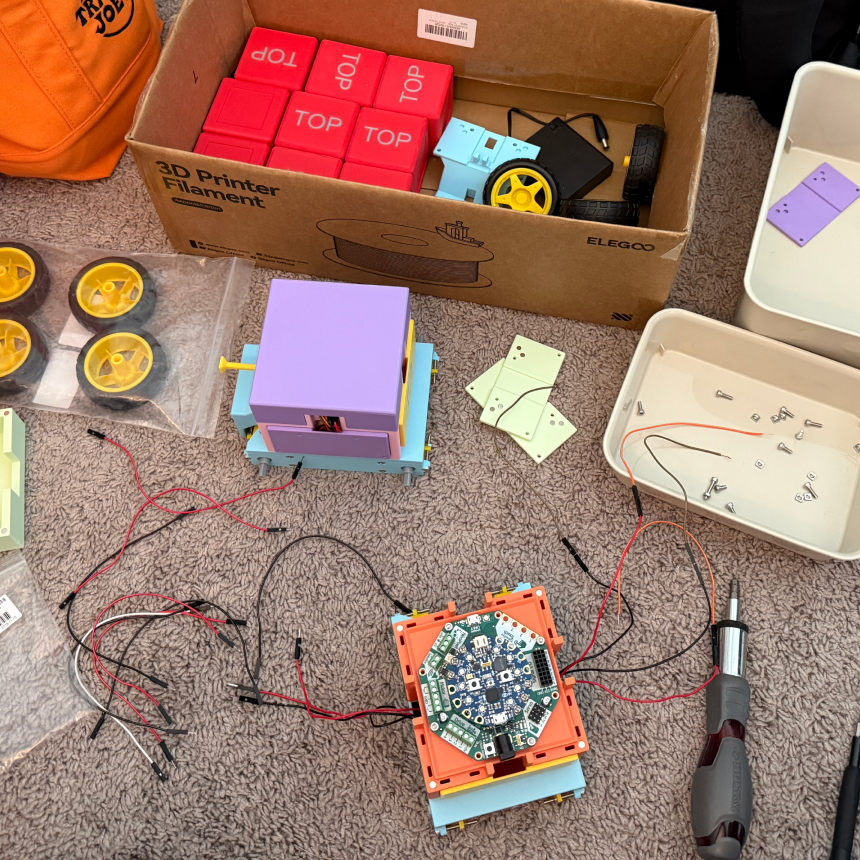
My solution is an open-standard mounting system built around three principles: off-the-shelf electronics, 3D printed parts, and universal connectivity. Rather than designing a closed kit with proprietary components, I set out to create a foundation that anyone can build on. All electronics and hardware (control boards, motors, lights, screws, and bolts) can be sourced from accessible retailers like Amazon and Adafruit. The mounting points for the control board can be easily swapped to suit individual needs. 3D printing is at the core of the system. It cuts the cost of structural parts significantly, and more importantly, it makes everything customizable. If a student wants to change a sensor, add a new function, or repurpose the robot entirely, they can, without remaking an entire robot from scratch. The mounting system allows for this flexibility, so students are never locked into one configuration. The result is a robot that grows with the student, not against them.